2010
03.09

In a typical week I’ll answer 5-6 emails asking about shipping parts outside of the United States and which method to choose. To hopefully clear up a few things for people I will discuss the options we offer and other important topics.

First things first, CorkSport will not under value shipments or label them as gifts. What you are asking us to do is to not be honest in declaring a shipments value to your government. This is like asking a US citizen to report something false to our IRS. It is something you just don’t do. The other catch on this subject is the USPS and UPS will not allow us to insure a shipment over the value of the declared parts. If you ordered a $500 part and asked us to declare it at $200 the maximum we could insure it would be $200. If the shipment gets lost or damaged there is no recourse with the carrier.

CorkSport has several options available for shipping overseas which boils down to two different carriers, the United States Postal Service aka USPS and United Parcel Service known as UPS. Each carrier has its own advantages compared to the other as I will explain below.

UPS delivers to most countries on the planet with the three options below.

UPS Express

is a 1-2 day shipment to most places on the planet. The only thing that can slow down the delivery for this option is customs in the country the shipment is going to. The brokerage fees when shipping by this method are included in the shipping cost. The duties and taxes for your country are not and UPS will collect them. Tracking is available and is updated often with UPS.

UPS Expedited

is a 3-5 day service. This is the economy service for air shipping via UPS. As with UPS Express, the brokerage fees are included in the shipping cost. The duties and taxes for your country are not and UPS will collect them. If you need something decently fast but it is not critical I recommend this option for most shipments. If you want to order something large like an exhaust system or larger, this is the shipment method we quote out. Tracking is available and is updated often with UPS.

UPS Standard

is a ground shipping option for Canada only. UPS Standard shipping takes from 3-10 days depending on where you are in Canada. CorkSport is located on the west coast in the USA. If you live on Prince Edward Island you can plan on the shipment taking 10 days to reach you. With UPS Standard the brokerage fees are NOT included in the shipping cost. The duties and taxes for your country are not as well and UPS will collect them. We get a phone call a week asking us why we did not change the shipping option from UPS Standard when someone places an order when UPS delivers a shipment and collects brokerage and duties. You the customer get to choose the shipping option. If you choose UPS for delivery we will ship it out via UPS.

USPS delivers everywhere on the planet and has multiple choices for shipping.

USPS Priority Mail International

is an option that takes 8-10 days to arrive to most countries. This does not include the time in customs once it arrives to the destination country. Sometimes customs can be quick with a 1-2 day delay. The worst case in customs I have seen was 10 days for Germany. This shipping option will require you to pay for duties and taxes for your country upon delivery. There is no brokerage fees charged. Tracking is available for Priority Mail services except for small flat rate envelope or box. Small flat rate will give us a customs form number but it is not traceable in the USPS system. Insurance is limited for Priority Mail in most countries to $600. If you have a shipment that is valued over $600 we will contact you about this to change shipping options. One drawback to Priority Mail is the maximum size limit which is 200 total centimeters length and girth.

USPS Express Mail Service

is a 5-6 day shipping option to most countries. Customs in your country can delay the shipment but we normally do not see this more than 1-2 days for Express Mail. When the Express Mail shipment arrives they will collect duties and taxes but there are no brokerage fees. Insurance levels are higher with Express Mail. For most countries the highest value for insurance is $2700. There are size limits with Express Mail which are similar to Priority Mail which limits the length and girth at 200 centimeters.

What I suggest for most shipments if the value is lower and the weight is less than 10 lbs, is to use USPS Priority Mail. It offers a decent shipping price for an international order and is very reliable. If you want to get an exhaust or intercooler kit shipped I recommend UPS Expedited. The shipment arrives quickly and insurance value covers the parts if there is damage or something goes missing. You also get your new exhaust or intercooler quickly with this method. If you order something large like a bumper or a quantity of a larger part I recommend you contact us for a shipping quote.

If you have any shipping questions feel free the contact us and we will help you with any shipping questions.

- Derrick

  • Share/Bookmark
2010
03.05

I went to the Portland Auto Show a few weekends ago to see the new cars for the upcoming year, I know we’ve talked about it already but I really wanted to talk about it. Ok, ok you got me, I really just want another opportunity to talk about / drool over the Mazda 2. Mazda brought a standard model green version to the show. They had it on a fancy display pedestal surrounded with one of those black rope separators you use to keep people in line at the bank.

My first thought after seeing the car in person is “small”. Seeing it in pictures and looking at one in person gives you a better scale of a vehicle size. If you haven’t seen a Mazda 2 in person it is bigger than a 88-92 Ford Festiva but smaller than a 90-94 323 hatchback.

On the outside the cars lines look better than pictures have shown. I walked around the car checking it out from all angles and I couldn’t find a spot that look off or I would want to change right off the bat. The wheels they used on the Mazda 2 are a good looking 8 spoke wheel.

One thing I did not see was the cool looking tail lights that can bee seen on the Japanese models. You can see the LED pattern in the tail light housing below. If they are not an option for North America we will be importing the lights.

I wasn’t allowed to hop in the car but I was able to get a good look at the inside. It is roomy for a small car. The inside of the car says Mazda 3. The trim, and design of the interior will make any Mazda 3 owners feel right at home. I had a chance to ride in a 2008 model tuned by AutoExe in Tokyo several years ago. The interior looks really close to the earlier models not sold in North America. Mazda says the interiors for the North America models will be upgraded and have a better feel. I am thinking this will be quality of materials more than styling.

Last but not least Mazda was giving away cool cans of Mazda 2 energy drink! They told me it tastes like Red Bull but I and going to save this souvenir.


Can -O-Zoom

While I was at the show I checked out the Ford Fiesta to see how close it was to the 2 since they share the same platform. The fit and finish of the Ford left something to be desired. From the exterior to the interior styling you can see where Mazda had put in little touches to make the car look or perform better. Even the exhaust on the Mazda 2 looked better constructed than the Fiesta.

After my trip to the auto show I can say I still want a Mazda 2 and I can’t wait to get one.

- Derrick

  • Share/Bookmark
2010
03.01

In that last blog we forgot to mention the best part!

In addition to recognition, we’ll be providing a $100 non transferable gift certificate to be used toward the purchase of any of our CorkSport line of products for the individual whose design is chosen. Additionally, we will be providing awards to the 2nd and 3rd place designers as well and sending the winning designed T-shirt to the top 5 designers.

Get those creative juices flowing and let’s see what you’ve got!

  • Share/Bookmark
2010
02.25

We love to hear some of the ideas our customers have when it comes to product development. You have some great ideas that have been shared with us in the last few months.

In keeping with our goal of providing excellent customer service and technical support to our customers, we would love to hear some of the tips and tricks that you use when doing installations, modifications or routine maintenance of your Mazda. Could be great ways to keep the oil from spilling all over the rotor housings on your RX-7 during an oil change (that upside down filter is a gem, isn’t it!), solutions to removing or reinstalling the downpipe on the MS3 (those studs don’t like to stay put in the turbo, do they!), or even something as simple as methods on how to keep your tools organized or functioning to their fullest.

In return, we’ll give a 10% discount code (not to exceed $25) for use toward any CorkSport Brand Parts to the top three tips submitted in the next three months.

Feel free to submit video, photos or diagrams to support your ideas.* The clearer you make the content, the better your chances are of getting the discount. We’ll publish the best tips here in our blog and give credit to everyone who submitted ideas. Submit your content to: wrenchtips@corksport.com.

For Example:

Here’s an tip I learned from an Aircraft & Powerplant mechanic who spent countless hours slogging through the muck repairing Aircrane Helicopters that had broken down in the field (or more appropriately out in the middle of nowhere in the woods). This trick was so helpful that he kept a can of Bon Ami sink cleaner in his toolbox. Aircraft and automobile engineers love to use phillips drive screws to hold all sorts of things together. And whether we ourselves have ham-fisted an install and thrashed the phillips drive in the top of a screw or it was the fault of the DPO (Dip-$&*%Previous Owner) , the solution is often times to get out the dremel and make it worse before it gets any better.

Alas, there is a solution that works perfectly, especially in those applications where the Phillips drive is HUGE and holds something on with substantial amounts of torque and your ‘bash it with a hammer’ impact screwdriver has eaten the top of the screw for breakfast.

So before you put all your weight into your battery powered screwdriver and turn what still looks remotely like a usable screw into a finely machined cone…take a deep breath. Go into the kitchen or (if you’re a bachelor and don’t know what this room in your house is for other than storing giant garbage bags of empty natty light cans) grocery store and pick up a can of abrasive sink cleaner like Bon Ami or another abrasive polishing powder. Mix it up into a paste and dip the end of your screwdriver into it. The paste is aggressive and will grab uneven surfaces of the drive in the screw and it will come right out. Make sure to continue to use plenty of downward pressure as well so the driver doesn’t just jump out of the contour of the screw. This trick also works well on partially rounded off hex drive fasteners like those M8 head exhaust manifold heat shield bolts on the MS3/MS6/CX-7.

Just don’t let your wife know that you’ve been stealing things out of the kitchen for use in the shop.

They don’t like that.

- Jason

*All content submitted will become the property of CorkSport.

  • Share/Bookmark
2010
02.22

HELP!

We’re running low on T-Shirts, and while this isn’t a random plea to ask for yours, we most certainly do need your help. While years ago, design was relegated to a select group of people who had mastered the skills of layout, design and illustration, today some of the most talented designers don’t even do that for a living. So we’re calling on our customers and other enthusiasts to help us come up with a design for the new CorkSport swag.

The only requirements are that the design be a two spot color layout in EPS vector format (or easily converted to vector format), and that it be creative. The only thing we’ve got as a starting point is the CorkSport Mazda Performance logo, available from us in vector format via email, or here.

The design will cover the back of the shirts and may also be used on other media. Credit will gladly be given via our blog, the description of the product on our website and we’ll allow you to either use your forum screen name, actual name or initials to autograph the design which will be printed on any of the products that carry this design.

If you have any questions, feel free to contact us or post comments on this blog or any of the forums where this is posted. We love working with our customers to help design the best products for your vehicles and we thought it would be fitting (pun intended) to bring our customers into the design process for our apparel as well.

Remember that we carry a full line of Mazda Parts for vehicles from the Familia 323 all the way up to the 2010 Mazda3 with all flavors of Piston, Rotary, FWD, RWD & AWD variants in between!

  • Share/Bookmark
2010
02.18

Friday Night at Taco7

On Friday the 29th I drove up to the Taco7 meeting in Federal Way, Washington to hang out with fellow rotary nuts for the evening. There was a good range of rotary power represented at the meeting despite the cold weather and rain. Unfortunately I was not able to bring any rotary power myself so I drove the CorkSport 2010 Mazdaspeed 3 instead, which worked out better for a customer who was getting his CorkSport header, racepipe, and cat back exhaust delivered. One of the cool things I saw at the event was a set of 1st gen RX-7 Re-Amemiya mirrors wit the built in air guide. It was the first time I had ever seen a set, and I’ve seen a lot of rare parts! There were several good looking RX-8s at the meet as well, including the one below which had the AutoExe brace sets installed. I love the way those braces look.

It was great getting to hang out with a bunch of rotary fans, if you own a rotary powered vehicle, you should come to the next Taco7 meet!

- Derrick

  • Share/Bookmark
2010
02.16

One of the most difficult development hurdles for any manufacturer of aftermarket parts is using the right design tools for the job. I’m prefer working in 3D Computer Aided Design (CAD) and Computer Aided Machining (CAM) systems and for me, it’s much easier to design up a product in the computer and be ready to go to production shortly thereafter than it is to fabricate something and then effectively reverse engineer the design into drawings and fixtures for the machine shop, tubing house and other fabrication vendors. But that requires that we start with some knowledge of where things are at on the vehicle in three dimensional space so we have a layout to work from.

Getting a good starting point to work from requires either a manufacturers computer model or skilled reverse engineering to generate that layout. There are a few ways to accomplish this -have ins with the factory and engineers at Mazda (which we have had for some time and are always dedicated to further developing), have the right tools to accurately and repeatably pull the information from the car into the CAD environment or by fabricating a working design and trying to refine that once it is complete. The difficulty of the latter method is that once you have a fabricated working design at hand, I find it a bit more difficult to think outside of the box or consider scrapping your hard work for a better design. Quick development turnaround time and being able to save multiple configurations of a design without cannibalizing the original by using CAD software makes thinking outside of the box a reality.

So what do we start with and where do we go when developing a product line?

Factory CAD Model Data

Having good connections and access to factory vehicle model content is, depending on manufacturer either extremely difficult or well facilitated through on board tech transfer programs. We’ll be gathering existing model data and comparing it to the vehicles we have in house for verification. In addition to this we’re hoping to broaden our relationship with Mazda to start gathering other CAD data where required to develop new and innovative products.

3D Digitizing Equipment

We recently had the opportunity to utilize some cutting edge technology for laying out future development on our 2010 MazdaSpeed3. Calling on Chris Jundt & Leta Holt at Hexagon Metrology, we worked with a Romer Infinite 2.0 Portable 4-Axis Coordinate Measuring Machine to digitize a number of areas on the Speed3 so that we can get a substantial boost in the return on our time invested in developing chassis bracing, molded fiberglass and rubber/urethane functional styling components and induction systems accessories. Consisting of a carbon fiber armature linked together by four extremely high resolution and accuracy Heidenhain Rotary Encoders and ending with a spherical ruby stylus, the Infinite 2.0 can map any elements that exist in an up to 4-12′ sphere (depending on model) to an extremely high accuracy and repeatability. This was just what our development for the 2010 MS3 needed. Our time mapping out the unibody and chassis components went quickly. We gathered data points on all of the rear hatch mount points and chassis bracing configurations that we had already mocked up into functional prototypes. When items were out of reach, we used the arm to generate a repeatable coordinate system which allowed us to move the arm and later stitch the two files back together seamlessly.

Using these technologies gives us the opportunity to develop a variety of improved designs as well expand our product market. And not only that, but it’s a lot of fun to be able to design parts as fluidly as you can sketch and erase on a chalkboard without consuming any raw materials until you’re satisfied with the results.

We’ll discuss more about how these technologies are assisting us in our upcoming blogs on chassis bracing solutions and R&D.

- Jason

  • Share/Bookmark
2010
02.11

Just got done doing the initial testing on our prototype cold air box for the 2010 MS3. We put a box together that is a bit different from our existing boxes on the previous generation vehicles.

Previously, we closed out the entire front corner of the engine compartment with the box. With the 2010, the fuse block is in that vicinity and there’s a large wiring harness that crosses over the boundary region where we profiled for the box edge. We were also curious to see if we could build an efficient box that would allow our customers to retain access to the headlight assembly and fuse block for quick bulb and fuse changes.

We’ve done three extended runs on the 2010 MS3 with Cold Air Box and come to some interesting conclusions. In previous tests on the MS3 and MS6, we found that the dynamic pressure zones under the hood of the vehicle can be counter-intuitive as to the areas that provide cold air and/or allow ingress of hot underhood air into the filter.

The first run with a box that had multiple areas of access to the hot zones in the engine compartment was surprisingly successful. On a 51F day, we hit a 40+ degree max differential between underhood (immediately outside the box) and filter surface temperatures. Not bad! On the hotter days (86F) this summer when we were running the tests on our MS6 we hit around 35 degrees max thermal delta.

The next test we performed was with a number of the holes and reliefs in the box (clearance around the silicone coupler, closeout to the headlight assembly and a clearance hole for the recirculation valve) shored up and sealed off, we took the car out for another run this morning (waiting specifically until the outside air temp hit 51 again). We were hoping to get to ambient air temperature, which would have been a 60 degree temperature differential. Just like the MS6 tests last year, we got close, but stopped short at 5 degrees above ambient for a maximum in the box to out of the box temperature differential of 51 degrees F.

Wanting to see that 5F disappear, we went berserk and busted out our mad Scotch packing tape fabrication skills and sealed the entire box off to body and inner fenderwell. Absolutely no change. Which was honestly a relief. The simpler we are able to make the design, the more margin we have to spend on the aesthetic design and provide our customers with design that looks as seamless as possible with the factory underhood environment. Justin did a great job with the initial mockup, matching the contour of the factory intercooler cover, but we’ve got a ways to go. Next step is to pull the box out, bust out the bondo and shaping tools to fine tune the look and feel of the box. Meanwhile I’ll be chucking some delrin up in the lathe to knock out some fittings and fasteners as well as fabricating some finished brackets to ensure a solid fit with the OEM airbox grommets, battery box and radiator crossmember.

Finally, I need to make some phone calls and get some quotes on a pre-preg Carbon Fiber lid as well as a Dry Carbon lid. We’d love to make this a reality, but the numbers confirm or deny the reality of that option.

I know you’ve all waited a long time for this and it’s been for good reason -we want to raise the bar with this design and we’re excited to make it a reality.

- Jason

  • Share/Bookmark
2010
02.09

About a month or so back, John and I decided to take on a new project. We managed to stuff 4 different chassis braces in the hatch of our 2010 Speed3…simultaneously. We have since had some time to test the various mount points back there to see where the best solutions would be provided. Our goal is to deliver a few different bars that can be mixed and matched and then deliver a secondary stage that will tie the primary bars together.

With that in mind, we know you love your trunk space and functionality on your hatchbacks and pass-through options on your sedans… So we have some tricks up our sleeve to make sure that your significant others will still be able to take a boosted trip to IKEA without complaining about the birdcage in the trunk getting in the way of that NORDANĂ– Armchair and VĂ„RDE Kitchen Cabinet.

Since our initial investment into the design of these systems and testing of them, we have come up with a few conclusions that have lead to some development of a final product that we’re hoping to have out in the next month or two. We looked at a number of elements of the design: bar material for optimal structural integrity, options for quick disconnects that provide solid mounting points and finally -the look that matches our existing products for the 2010 vehicles.

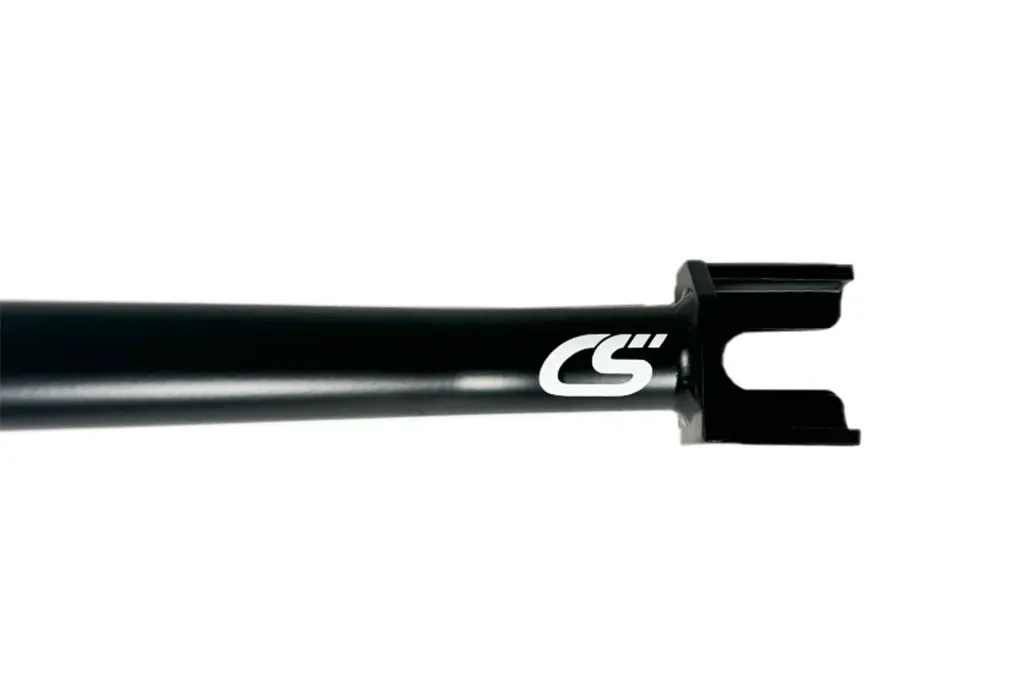
In order to do this, we wiped the drawing board clean and started with a 1″ solid aluminum section of bar stock, black anodized with a laser etched CorkSport logo. We then evaluated the bracketing systems and methods of making solid, quick disconnect systems that will prevent chassis flex, yet provide our customers the ease of removal on the fly. I used to work in Aircraft, and whenever we wanted to make systems quickly removable we would use aircraft seat track systems with quick latching lugs and push-button quick release pins that are reliable and can handle a substantial load.

In order to accommodate these features, our designs require a higher level of accuracy and tolerance control than we are afforded with our welded style one-piece bars. Which means the brackets and the endlinks have to adhere to a high accuracy in their diameter and their overall thickness so that the grip length of the quick release pins will hold the system together accurately.

Mind you, using hardware like this to provide the best options to our customers are not by any means inexpensive. But that forces us to use all of the tools we have to minimize the cost of our designs simply through their manufacturability and through the process of minimizing part counts and simplifying design and build processes.

What we end up with are chassis braces that you can disconnect on the fly without any specialized tools. We’re still working on ways to make the integration of these systems appear as though they were factory solutions, because we know when you pop the hatch on your brand new Mazda3 or Mazdaspeed3, your friends and coworkers don’t expect to see your carpet and interior panels hacked up with a load of scaffolding occupying what should be usable trunk space….

The best part is that from the exterior of the vehicle, to the under-hood to the hatch and interior, you’ll find a consistent product line that expresses a level of quality commensurate with your 2010 Mazda. We look forward to sharing some of our other new designs in the near future. And we can’t wait to discuss some new ideas and directions with you. Keep in touch with us if you have any comments or ideas about product development or the direction we are taking with our designs.

- Jason

  • Share/Bookmark
2010
02.04

90 years is quite a time span in human lives. The average life span is 67 years in the world today. Mazda (Toyo Kogyo) will be celebrating 90 years in 2010. We can thank Jujiro Matsuda for getting the company going in 1920 which led to the manufacturer of the cars we all love to drive. So for the 90 anniversary what is Mazda up to? I myself was hoping for something crazy to show up but it looks like there is just going to be a few special edition models available in Japan.

There will be a special “Gunmetal Blue Mica” version of the Mazda 3 (Axela in Japan) equipped with the 2.0 DI engine and I-Stop is available.

So far there are no plans for the 90th Anniversary Mazda 3 to make it to North America but that could change if we protest enough.

Mazda also has plans for a 90th Anniversary version of the Biante. A Biante is a compact minivan in the Japanese market. It will be available with the same 2.0 DI engine and I-Stop as well. I have not been a fan of the Biante styling myself but for its size you can haul 6 people comfortably and some cargo. Think of it as a different looking Mazda 3.

Who knows maybe Mazda will surprise us this year with a new rotary powered machine for the 90th anniversary. So far it has been quiet from my contacts in Japan but you never know. Mazda could be keeping a surprise on the down low.

- Derrick

  • Share/Bookmark